
Camel
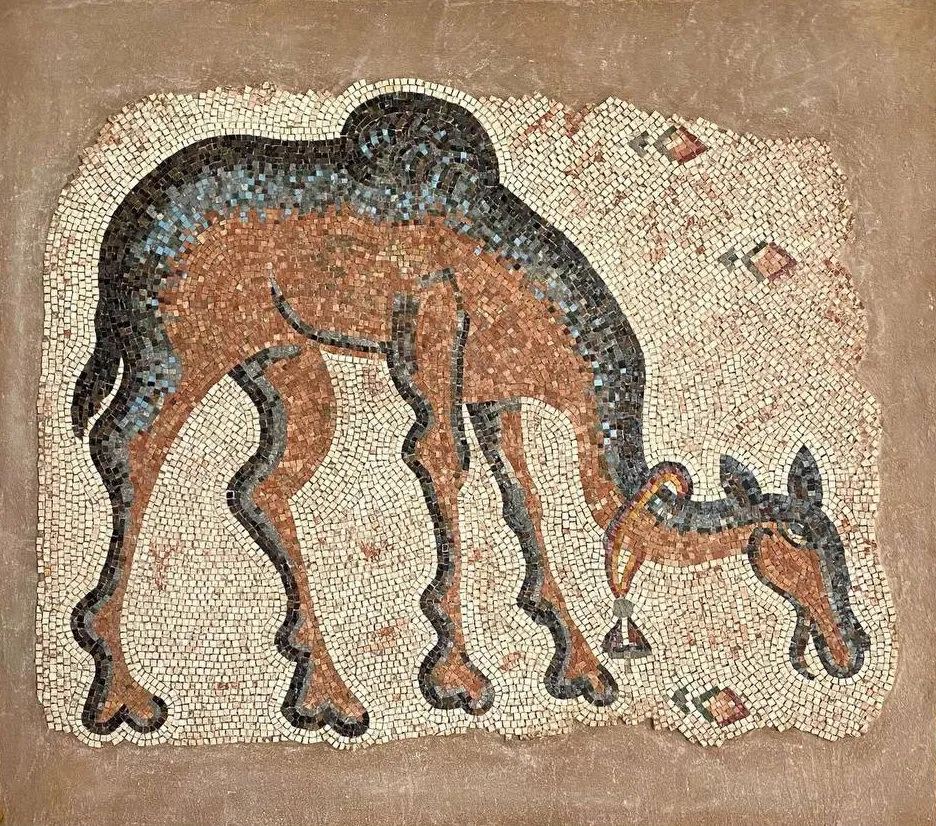
Interpretation of a mosaic fragment with a grazing camel, V century AD, Art Institute of Chicago
“First, the spirit becomes a camel: it loves the burden, it seeks trials. It says ‘yes’ to everything that demands effort…” — Friedrich Nietzsche
In this mosaic, for me, the camel is not merely a desert animal, but as a symbol of path, patience, and inner maturity.
It carries upon itself the weight of traditions, knowledge, obligations — everything that shapes a person at the beginning of their life’s journey.
The camel is the archetype of the student, the bearer of meaning, the custodian of Spirit in the dry lands of the unconscious.
Its path leads through the silent desert — through trials and solitude, where strength is born. It knows that the source lies deeper — within. It can walk for a long time without external sustenance, because it carries its own “water” — the water of Spirit, wisdom, and memory.
And somewhere in the depths of this story a song from my childhood sounds:
“Up the mountain went the camel. Look, what a funny sight! What kind of route is that, if it is so dangerous? Stones rolled down the mountain to its feet, but the camel calmly walked toward distant peaks, where the snows lie… Pa-ru-ra!”
It is like an incantation of resilience. A childhood truth understood only in adulthood: resilience is not stubbornness, but knowing why you are walking.
This mosaic is a reminder humility is not weakness but strength. And that each of us, before becoming the creator of our own reality, passes through a stage of accumulation — and without it there is no true freedom.
The camel is the first step in the great journey of the soul. After it comes the lion. Then the child. But everything begins here — with the one who silently walks, carries, and knows.